Showing posts with label Days That Shook The World. Show all posts

Wednesday, February 16, 2011

TODAY IN HISTORY: The Discovery Of King Tut's Tomb (1923) - Days That Shook The World

On this day in 1923, in Thebes, Egypt, English archaeologist Howard Carter enters the sealed burial chamber of the ancient Egyptian ruler King Tutankhamen.
 Howard Carter
Because the ancient Egyptians saw their pharaohs as gods, they carefully preserved their bodies after death, burying them in elaborate tombs containing rich treasures to accompany the rulers into the afterlife. In the 19th century, archeologists from all over the world flocked to Egypt, where they uncovered a number of these tombs. Many had long ago been broken into by robbers and stripped of their riches.
When Carter arrived in Egypt in 1891, he became convinced there was at least one undiscovered tomb--that of the little known Tutankhamen, or King Tut, who lived around 1400 B.C. and died when he was still a teenager. Backed by a rich Brit, Lord Carnarvon, Carter searched for five years without success. In early 1922, Lord Carnarvon wanted to call off the search, but Carter convinced him to hold on one more year.
In November 1922, the wait paid off, when Carter's team found steps hidden in the debris near the entrance of another tomb. The steps led to an ancient sealed doorway bearing the name Tutankhamen. When Carter and Lord Carnarvon entered the tomb's interior chambers on November 26, they were thrilled to find it virtually intact, with its treasures untouched after more than 3,000 years. The men began exploring the four rooms of the tomb, and on February 16, 1923, under the watchful eyes of a number of important officials, Carter opened the door to the last chamber.
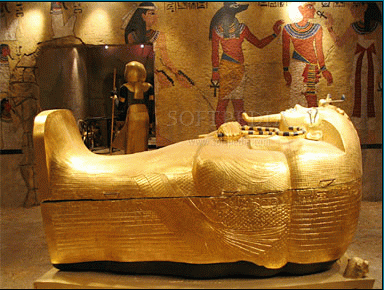
 Inside lay a sarcophagus with three coffins nested inside one another. The last coffin, made of solid gold, contained the mummified body of King Tut. Among the riches found in the tomb--golden shrines, jewelry, statues, a chariot, weapons, clothing--the perfectly preserved mummy was the most valuable, as it was the first one ever to be discovered. Despite rumors that a curse would befall anyone who disturbed the tomb, its treasures were carefully catalogued, removed and included in a famous traveling exhibition called the "Treasures of Tutankhamen." The exhibition's permanent home is the Egyptian Museum in Cairo. 

Sunday, February 13, 2011

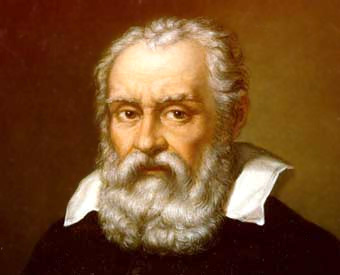
TODAY IN HISTORY: Galileo Trial - DAYS THAT SHOOK THE WORLD

On this day in 1633, Italian philosopher, astronomer and mathematician Galileo Galilei arrives in Rome to face charges of heresy for advocating Copernican theory, which holds that the Earth revolves around the Sun. Galileo officially faced the Roman Inquisition in April of that same year and agreed to plead guilty in exchange for a lighter sentence. Put under house arrest indefinitely by Pope Urban VIII, Galileo spent the rest of his days at his villa in Arcetri, near Florence, before dying on January 8, 1642.
 Galileo, the son of a musician, was born February 15, 1564, in Pisa, Italy. He entered the University of Pisa planning to study medicine, but shifted his focus to philosophy and mathematics. In 1589, he became a professor at Pisa for several years, during which time he demonstrated that the speed of a falling object is not proportional to its weight, as Aristotle had believed. According to some reports, Galileo conducted his research by dropping objects of different weights from the Leaning Tower of Pisa. From 1592 to 1630, Galileo was a math professor at the University of Padua, where he developed a telescope that enabled him to observe lunar mountains and craters, the four largest satellites of Jupiter and the phases of Jupiter. He also discovered that the Milky Way was made up of stars. Following the publication of his research in 1610, Galileo gained acclaim and was appointed court mathematician at Florence.
Galileo's research led him to become an advocate of the work of the Polish astronomer Nicolaus Copernicus (1473-1573). However, the Copernican theory of a sun-centered solar system conflicted with the teachings of the powerful Roman Catholic Church, which essentially ruled Italy at the time. Church teachings contended that Earth, not the sun, was at the center of the universe. In 1633, Galileo was brought before the Roman Inquisition, a judicial system established by the papacy in 1542 to regulate church doctrine. This included the banning of books that conflicted with church teachings. The Roman Inquisition had its roots in the Inquisition of the Middle Ages, the purpose of which was to seek out and prosecute heretics, considered enemies of the state.

Today, Galileo is recognized for making important contributions to the study of motion and astronomy. His work influenced later scientists such as the English mathematician and physicist Sir Isaac Newton, who developed the law of universal gravitation. In 1992, the Vatican formally acknowledged its mistake in condemning Galileo.

Saturday, February 12, 2011

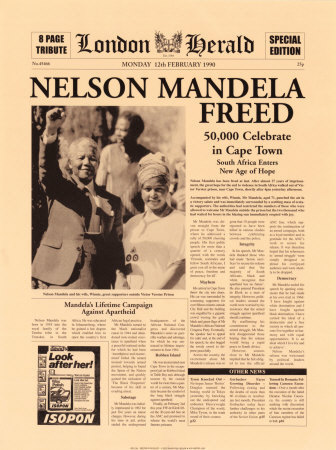
TODAY IN HISTORY: The Release Of Nelson Mandela (1990) - Days That Shook The World

Nelson Mandela, leader of the movement to end South African apartheid, is released from prison after 27 years on February 11, 1990.

In 1944, Mandela, a lawyer, joined the African National Congress (ANC), the oldest black political organization in South Africa, where he became a leader of Johannesburg's youth wing of the ANC. In 1952, he became deputy national president of the ANC, advocating nonviolent resistance to apartheid--South Africa's institutionalized system of white supremacy and racial segregation. However, after the massacre of peaceful black demonstrators at Sharpeville in 1960, Nelson helped organize a paramilitary branch of the ANC to engage in guerrilla warfare against the white minority government.
In 1961, he was arrested for treason, and although acquitted he was arrested again in 1962 for illegally leaving the country. Convicted and sentenced to five years at Robben Island Prison, he was put on trial again in 1964 on charges of sabotage. In June 1964, he was convicted along with several other ANC leaders and sentenced to life in prison.
Mandela spent the first 18 of his 27 years in jail at the brutal Robben Island Prison. Confined to a small cell without a bed or plumbing, he was forced to do hard labor in a quarry. He could write and receive a letter once every six months, and once a year he was allowed to meet with a visitor for 30 minutes. However, Mandela's resolve remained unbroken, and while remaining the symbolic leader of the anti-apartheid movement, he led a movement of civil disobedience at the prison that coerced South African officials into drastically improving conditions on Robben Island. He was later moved to another location, where he lived under house arrest.

In 1989, F.W. de Klerk became South African president and set about dismantling apartheid. De Klerk lifted the ban on the ANC, suspended executions, and in February 1990 ordered the release of Nelson Mandela.
Mandela subsequently led the ANC in its negotiations with the minority government for an end to apartheid and the establishment of a multiracial government. In 1993, Mandela and de Klerk were jointly awarded the Nobel Peace Prize. One year later, the ANC won an electoral majority in the country's first free elections, and Mandela was elected South Africa's president.